Paintless Dent Repair or Real Bodywork? How to Tell What Your Car Needs
A guy came in last spring with a 2020 Camry. A shopping cart had rolled into the rear door in the Publix lot over by Conway. Nice round dent. Paint still perfect, no crease. He figured he was looking at a few hundred bucks and two days without his car.
He had it back that same afternoon. Paintless dent repair. No paint, no filler. That's the kind of job PDR was made for.
Two weeks later a different car rolled in with what looked like the exact same problem, and that one needed full bodywork. So how do you tell which is which before you spend money? That's what this is about.
What is paintless dent repair, really?
Paintless dent repair (PDR) is pretty much what it sounds like. We massage the metal back to its original shape from behind the panel, using specialized rods and tools, with no sanding, no filling, no repainting. Your factory paint stays put.
That matters more than people think. Factory paint is baked on at the plant, and it's tougher than anything we can spray in a booth. So keeping it is a real win.
When PDR works, it's the better repair. Cheaper, faster, original finish untouched. The catch is that it only works under certain conditions.
The paint has to be intact. The metal can't be stretched or torn. And we need access to the back of the panel, which isn't always possible depending on where the dent landed and how the car's built.
When does paintless dent repair actually work?
Here's where PDR earns its keep.
Door dings. The classic one. Somebody in the next spot swings their door into yours. Round, shallow, paint untouched. That's almost always a PDR job.
Hail damage. We don't get hail like the Midwest does, but Central Florida gets it, usually with those nasty summer storms that blow through in the afternoon. One bad cell can leave a hood and roof peppered with dozens of little dents. As long as the paint didn't crack, PDR knocks those out one at a time, and it's far cheaper than repainting a whole roof. That's also why most insurance companies push for it on hail claims. Smaller bill.
Shallow dents on a smooth stretch of metal, with good access behind. The middle of a door. The flat of a hood. Those work well.
Body line dents, sometimes. If a dent caught the edge of a body line but didn't put a sharp crease in it, a skilled tech can often still work it out. That one's a judgment call, and it depends a lot on the exact dent.
I'll be straight with you. PDR is a skill, and not every shop that advertises it is actually good at it. A sloppy PDR job can leave the panel looking wavy in the right light. Ask whoever you go to how many years they've been doing it.
When do you actually need traditional bodywork?
Now the other side. PDR has hard limits, and pushing past them just burns your money.
If the paint is cracked, chipped, or scratched down to bare metal, you need bodywork. No way around it. PDR doesn't touch paint, so a cracked finish stays cracked. We'd be smoothing the dent under broken paint, which fixes nothing.
Sharp creases are the big one. When a dent has a hard, knife-like line running through it, the metal there is stretched. Stretched metal can't just be pushed back. It's permanently deformed. That takes filler, sanding, and paint to look right again.
Dents on the very edge of a panel, near a seam, or sitting over a brace where we can't reach the back. No access, no PDR.
Plastic bumpers trip people up. Your bumper cover is plastic, not metal, and it behaves nothing like a steel door. Sometimes we can reshape it with heat. But a cracked or gouged bumper is a paint-and-repair job, not PDR.
Anything with rust, old body filler, or a panel that's been repainted before. PDR needs healthy original metal and paint. If somebody already worked that spot, all bets are off.
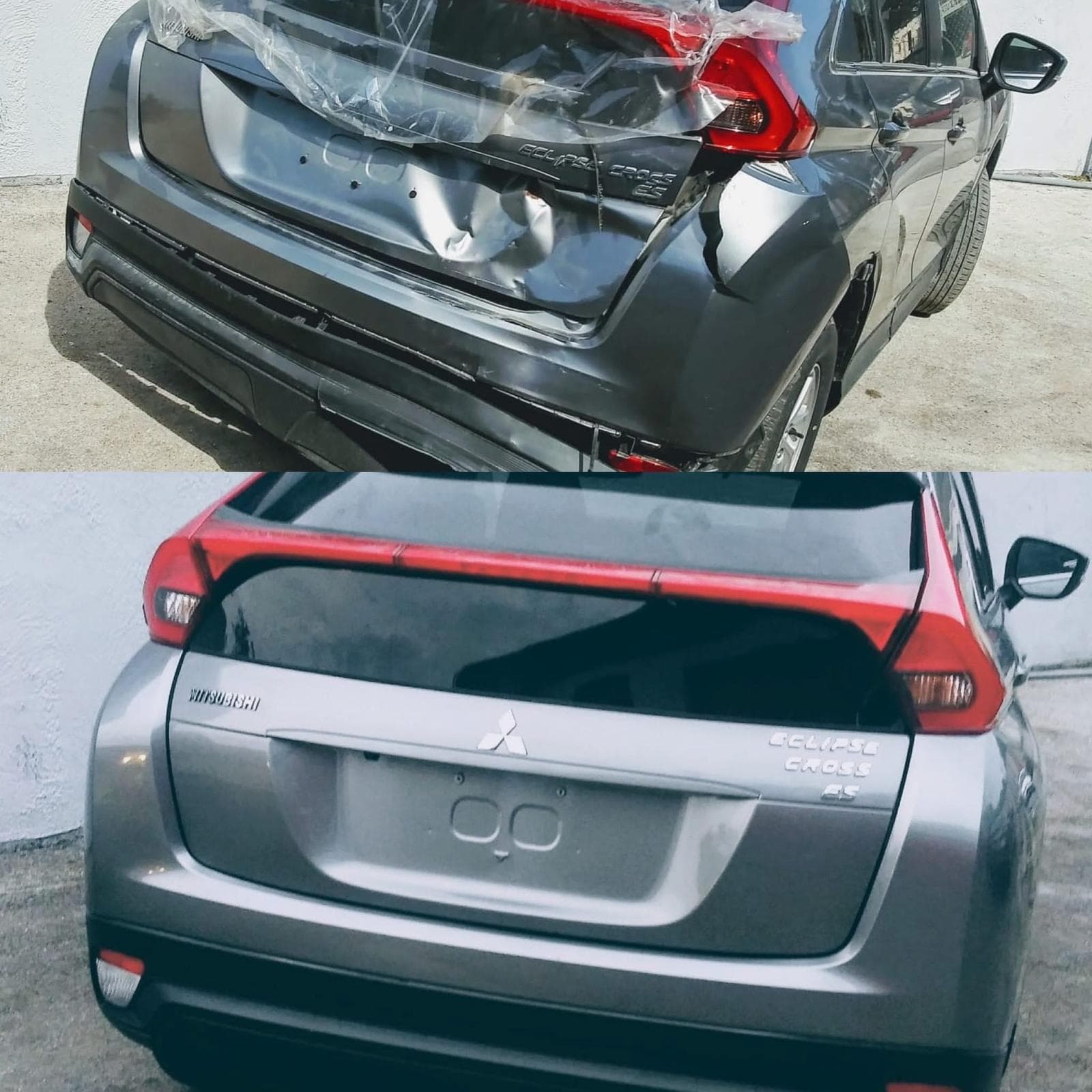
And collision damage, obviously. If you got clipped on I-4 and the quarter panel is folded in, that's not a dent anymore. That's bodywork, maybe frame and structural work too, depending on how hard you got hit.
How much does each one cost, and how long does it take?
Real numbers, because that's what everybody actually wants. These are Orlando-area ballparks, and your car will land somewhere on the scale.
A single door ding with PDR usually runs 75 to 150 dollars. A few dings on one panel, maybe 150 to 350. Hail jobs come down to dent count and can run anywhere from a few hundred to a couple thousand if the whole car got hammered. Even at the top end, that beats repainting every panel.
Traditional bodywork on one panel (filler, primer, base coat, clear) typically starts around 500 dollars and climbs from there. Depends on the panel, the paint, and whether we have to blend into the panels next to it to match the color. Pearls and tri-coat finishes cost more because matching them is genuinely a pain.
Time is the bigger gap. PDR can be same day. A handful of dings, sometimes an hour at the counter. Bodywork needs cure time between every step. Paint has to flash. Clear has to harden. We're not rushing that and handing you back something that fails in six months. Figure three to five business days for a normal paint-and-body repair, more if a part is slow to show up.
That cure-time point is worth sitting on for a second. Our heat and humidity are rough on a fresh paint job that didn't get the time it needed. A shop that promises bodywork back in a day is either cutting corners or only doing half the job. Quick is fine for PDR. For paint, slow and right beats fast and peeling off by next summer.
So which one do you need?
Quick gut check you can do right in the parking lot. Run your fingernail across the dent. Does it catch on a crack or a scratch? Probably bodywork. Smooth paint, rounded dent, no sharp line? Probably a PDR candidate.
Honestly though, the fingernail test only gets you so far. A dent can look minor and still hide a stretched body line you'd never spot on your own. That's the whole reason to get eyes on it.
That's what the free estimate is for. Bring it by, we'll put it under good light, push on it a little, and tell you straight whether PDR will do the job or whether it needs the full treatment. If it's a clean PDR fix, we'll say so, even though it's the smaller ticket. We'd rather you trust us with the next one.
We work with every insurance carrier, and looking at it doesn't cost you a thing. Got a dent you've been wondering about? Swing by or give us a call and we'll take a look.
Quick answers
Will paintless dent repair leave any mark on my car?
Done right, no. A good PDR tech works the metal back to its original shape from behind the panel, so there's no filler and no repaint. If you can still find the spot afterward, it usually means the dent was too sharp for PDR in the first place, or the paint had already cracked. We'll tell you up front if we think you'll see anything once we're finished.
Does insurance cover paintless dent repair for hail damage in Florida?
Usually, yes. Most carriers we deal with in Orlando (State Farm, GEICO, Progressive, Allstate) treat hail as a comprehensive claim, and PDR is often the fix they want because it costs less than a repaint. Bring your estimate and your policy info. We handle the claim paperwork either way.
How long does paintless dent repair take versus regular bodywork?
A few door dings can be done same day, sometimes in an hour or two. A car worked over by hail might take two or three days, depending on the dent count. Traditional bodywork that needs filler, primer, paint, and clear runs three to five business days for a panel or two. Longer if parts are on backorder or the color is tricky to blend.
Can you fix a deep crease or a dent with chipped paint without a repaint?
Not cleanly. Once the paint is cracked or the metal is stretched from a sharp crease, PDR can't bring the finish back. We'd just be hiding a problem instead of fixing it. Those go to the bodywork side so you get a repair that actually holds up to Florida sun and humidity.