How Long Does Collision Repair Really Take? An Honest Answer From Our Orlando Shop
Short version. A small bumper job might be out the door in two or three days, and a bad wreck can sit in the shop for a month or more. That spread drives people nuts. I get it. You want a number you can plan your week around. So let me walk you through what really sets the clock, the way I'd explain it to you standing at our counter on Tiner Ave.
Most folks figure the timeline is about how hard the work is. It usually isn't. It's about four things stacking up on top of each other: parts, hidden damage, insurance approval, and paint. Any one of them can park a car that's otherwise ready to roll out.
How long does collision repair take on average?
Here's the honest range. The kind we actually see week to week here in Orlando.
A scuffed or cracked bumper cover, repaired and repainted, runs two to four days. A fender bender with a panel or two and some paint blending, no airbags and no frame work, is usually three to seven business days. Step up to moderate damage, say a door plus a quarter panel and a headlight assembly, and now you're looking at one to two weeks. Then there's the heavy stuff. Frame or unibody damage, deployed airbags, a structural pull on the bench, a dozen parts on order. That's three to six weeks. Sometimes longer if a part is sitting on a national backorder and nobody in the country has it.
Those are working days, not calendar days. A job that "takes a week" of actual labor can still hand you your car ten days later once you count a weekend and a slow approval in the middle.
There's a rough rule of thumb the industry leans on too. About one day of repair time for every $500 to $750 of damage. It's loose, and I wouldn't bet money on it. But if your estimate comes in at $4,000, don't expect to pick the car up tomorrow.
What actually drives the timeline?
This is where the real answer lives. Four things. Let me take them one at a time.
Parts. This is the number one reason a car just sits. We can't bolt on what we don't have. A bumper cover for a 2019 Camry? Probably in our hands next day. A grille, or a sensor bracket for a less common trim, or anything on a newer model with a chip-dependent module, can take a week or three. Back during the worst of the supply mess a couple years ago, I had a Silverado parked here almost a full month waiting on a single tailgate. The body work was finished in days. We were just standing around watching the bay, waiting on a truck to roll in.
OEM parts, the ones straight from the manufacturer, sometimes take longer than aftermarket. They fit right, though, and your insurer may or may not agree to pay for them. That's a conversation we have with you early, not at the end.
Hidden damage. You can't price what you can't see. The estimate somebody wrote in a parking lot, or off the photos on your phone, is a starting guess. Not the real number. Once we pull the bumper and actually start the teardown, we find what the impact really did. A bent reinforcement bar. A cracked bracket. A radiator support that took the brunt of it, with a condenser quietly leaking behind it.
That's normal. On collision jobs it's more the rule than the exception. When we find it, we write what's called a supplement, send it to your insurance, and wait for the green light before we order those extra parts. Which leads straight into the next holdup.
Why does insurance approval slow everything down?
Because nobody at the shop can spend the insurance company's money without their sign-off. Simple as that.
When we find hidden damage and submit that supplement, the clock stops on those parts until the adjuster reviews it and approves it. Some carriers turn it around the same afternoon. Some take three or four days. A few will push back on a single part or a procedure and ask for more photos, and that little back-and-forth can quietly tack on a week that has nothing to do with anybody turning a wrench.
We handle all of that for you. We work with every carrier you can name, GEICO, State Farm, Progressive, Allstate, USAA, and we stay on them to keep approvals moving. But I can't make an adjuster click approve any faster than they're going to click it. I won't pretend I can.
One thing worth knowing if you live here in Florida. You get to choose your own shop. Your insurer can suggest one, sure. They can't force it on you. So you're never stuck in a slow lane just because a carrier tried to steer you to their preferred place.
How long does the paint and cure time take?
People underestimate this part every single time. They picture paint as a couple hours of spraying. It is not.
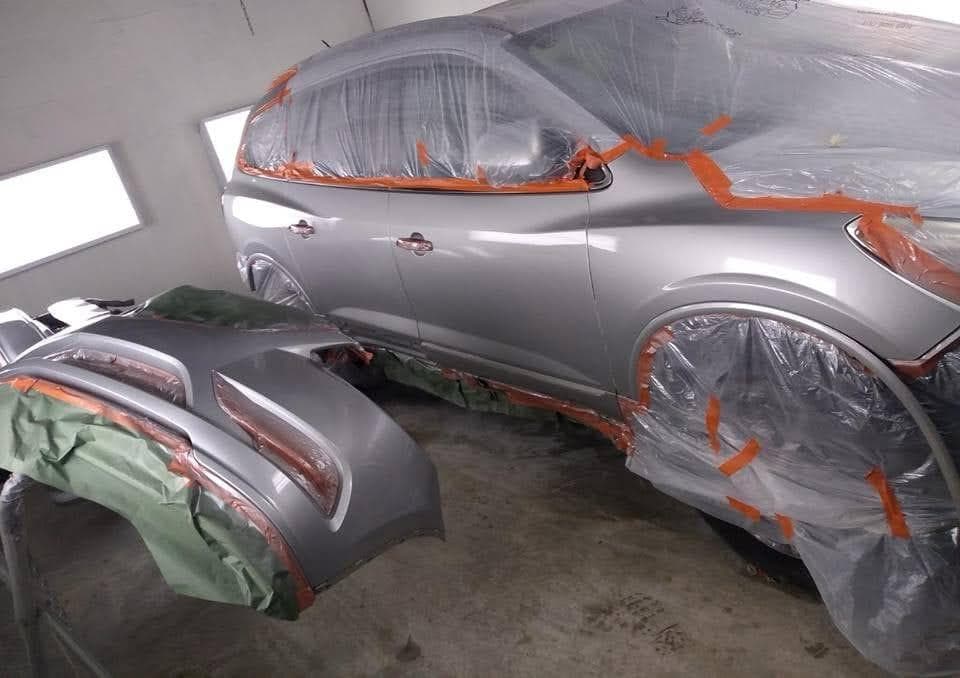
Before any color goes on, the panel gets repaired, sanded, masked off, and primed. The primer has to cure. Then we color match. We use computerized matching and we still spray a test card first, because a silver from 2018 has faded differently than the same paint code fresh out of the gun. And sun-baked Florida paint is its own animal. Parked outside in Central Florida all summer, the clear cooks. After that, base coat. Then clear coat. Each layer needs flash and cure time in the booth, and we bake it to set the finish right.
Rush any of it and you get problems. Runs. Fisheyes. Clear that hazes or starts peeling at the edge inside a year. I've watched cars come out of a quick-turn shop looking great for a month, then the paint lifts along the seam. Not happening on your car.
Realistically, paint and refinish alone is one to three days on most jobs. More if several panels need blending so the repair vanishes into your existing finish instead of standing out as a fresh patch. After that comes reassembly, a wash, a detail, and a final inspection where we go over the car panel by panel before you ever lay eyes on it.
So why did my neighbor's car take twice as long as mine?
Probably because their wreck hit one of those four pressure points and yours didn't.
Maybe their car needed a part stuck on backorder somewhere in a warehouse in another state. Maybe teardown turned up a bent frame rail nobody spotted in the parking lot. Maybe their adjuster sat on the supplement for a week. Two cars with the identical dented door can finish days apart for reasons that have zero to do with how fast either shop swings a hammer.
Here's what speeds things up on your end. Get us clear photos early, or better yet, bring the car in so we can do a real teardown instead of guessing from a screen. Say yes quickly when we call for approval. And ask about rental coverage on day one. If your policy caps rental days, a long parts delay can leave you paying out of pocket while you wait, and that stings.
We'll give you a real range once we've actually seen the damage. And we'll call you the minute something changes. No vanishing for a week. No "it'll be ready soon" three times in a row. If a part's stuck in a warehouse, you'll hear it from us straight.
Got a car that's banged up and you're trying to figure out how to get to work next week? Bring it by the shop or text us a few photos. We'll look it over, give you a straight timeline, and deal with your insurance from there. Free estimate, no pressure, and you'll actually know what you're waiting on.
Quick answers
Can you give me an exact date my car will be done?
On day one, no. And be careful with any shop that swears to one before they've torn anything down. We give you a realistic range after teardown, once we can actually see what we're dealing with. Then we update it if parts or insurance approval shift things around. A good early estimate gets tighter and more accurate as the job goes, not looser.
Does my insurance company control how long the repair takes?
They control one piece. How fast they approve the estimate and any supplements. A slow adjuster, or a back-and-forth over which parts they'll pay for, can add days. The actual repair speed is on us. And in Florida you get to pick your own shop, so you're never stuck waiting on whoever your carrier wanted to steer you to.
Why does paint take so long if it's just spraying a panel?
Spraying is the fast part. The drying and curing between primer, base, and clear is what eats the clock. Add the masking, the sanding, the color matching before any paint hits the car. Rush it and you get fisheyes, runs, or a finish that fails inside a year. We'd rather take the extra day.
Will a rental be covered while my car is in the shop?
That's between you and your policy, not us. If you carry rental reimbursement, it usually covers a set number of days or a daily dollar cap (think $30 to $50 a day on a lot of policies). Long repairs can blow past that limit. One more reason hidden damage and parts delays hit your wallet, not just your patience. Ask your adjuster what your rental coverage actually allows before you assume.