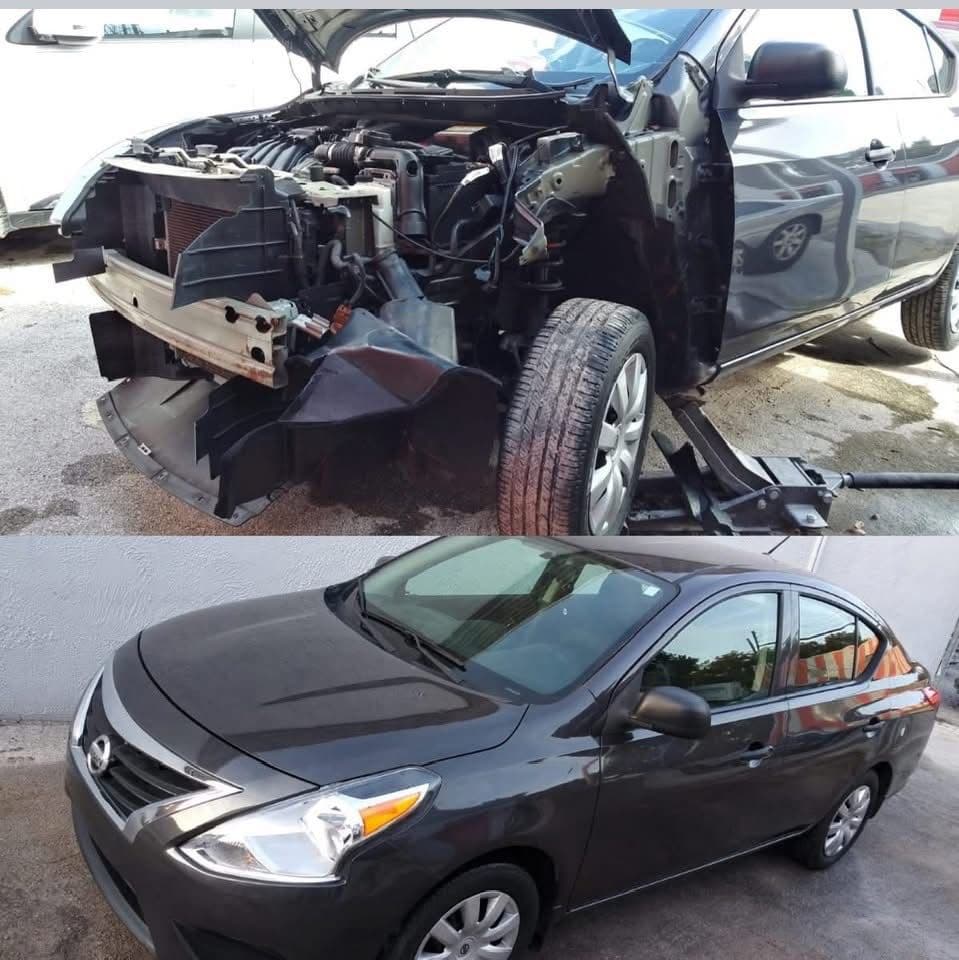
How Florida Decides If Your Car Is a Total Loss (the 80% Rule), and What You Can Do About It
You can have a car that drives, steers, and stops just fine, and Florida will still call it a total loss. That surprises people. They walk in here after a wreck near Lake Nona or off the 417, the car looks rough but fixable, and the insurance company has already written it off. How does that happen when the thing isn't even close to wrecked beyond repair?
It comes down to one number. Eighty percent. Let me walk you through exactly how that works, with real Orlando dollars, so you know what you're dealing with and what you can actually do about it.
How does Florida decide a car is a total loss?
Florida uses what's called the Total Loss Threshold, and it lives in state law, Florida Statute 319.30. The rule is simple to say and easy to miss. If the cost to repair your car reaches 80 percent or more of what the car was worth right before the accident, it's a total loss. Full stop.
That pre-accident number has a name too. Actual Cash Value, or ACV. It's basically what your car would've sold for the morning of the crash, given its year, mileage, condition, and options. Not what you paid. Not what you owe. What it was worth that day.
So the formula the insurer runs is this. Take the repair estimate. Sometimes they add the cost of your rental car during the repair. Divide that by the ACV. If you land at 80 percent or higher, the car gets totaled.
Here's the part that catches folks off guard. Florida's 80 percent is stricter than a bunch of other states. Plenty of places don't total a car until repairs hit 100 percent of its value, or run a fancier formula that factors in salvage. Florida just draws the line at 80. So a car that would get fixed in Georgia or Texas can get written off here on the same damage. It's not the adjuster being cheap. It's the statute.
What does the 80 percent rule look like in real dollars?
Numbers make this click, so let's run a couple.
Say you've got a 2019 Toyota Camry, decent shape, and the pre-accident value comes back at $18,000. Multiply that by 80 percent and you get $14,400. That's your total-loss line. If the repair estimate comes in at $13,000, you're under the line, and the car gets fixed. If it comes in at $15,000, you've crossed 80 percent, and it's totaled, even though $15,000 of repair on an $18,000 car sounds fixable to most people.
Now flip it. A 2014 Honda Civic with high miles might only carry an ACV of $7,500. Your line there is just $6,000. A solid front-end hit with airbag deployment can blow past $6,000 fast, because airbags alone run a few thousand to replace and recalibrate. Older, lower-value cars total out way easier than people expect. That same damage on a newer car worth $25,000 wouldn't come close to the threshold.
This is why the ACV is the number that decides everything. If the insurer sets your Camry's value at $15,000 instead of $18,000, your total-loss line drops to $12,000, and now that $13,000 repair tips the car into a total loss. Same damage, different outcome, all because of how they valued the car. Pay attention to that number. It's where the real fight is.
What actually happens if my car gets totaled?
The insurer doesn't pay to fix it. They pay you the actual cash value, minus your deductible if it's your own collision claim, and they take the car. The wrecked vehicle goes off to salvage and gets a salvage-branded title.
Sounds clean. Two things bite people here.
First, ACV is often way less than your loan balance. If you bought that Camry two years ago and still owe $20,000 but the car's only worth $18,000, the insurer pays $18,000 and you're stuck owing the other $2,000 to the lender. That gap is yours unless you carry gap insurance. Newer financed cars get hit hardest because they depreciate fast in the first few years.
Second, even the payout itself can feel low. Insurers pull value from pricing tools that don't always know your car had new tires, fresh brakes, or a timing belt done last spring. They start with a base number and it's on you to add the rest back.
Can I keep my car after it's totaled?
A lot of the time, yes. It's called an owner-retained salvage, and people do it all the time when the damage looks worse on paper than it really is.
Here's the trade. The insurer figures out the salvage value, basically what they'd have gotten by selling the wreck to a salvage yard, and they subtract that from your settlement. So instead of the full $18,000, you might get $18,000 minus a $4,000 salvage figure, so $14,000, and you keep the car. Then it carries a salvage title. To put it back on the road legally in Florida you have to actually repair it, then pass a rebuilt-vehicle inspection through the state (FLHSMV) before they'll issue a rebuilt title and let you register it.
Should you do it? Depends entirely on the math, and this is where we earn our keep. Bring it by and we'll give you a straight repair number. If the real cost to fix it right, plus that salvage deduction, comes out cheaper than the value you're keeping, it can be a smart move. If it's close or upside down, walk away and take the check. We've told plenty of people to take the check. That's the honest answer some of the time.
What if I disagree with the insurance company?
You don't have to just accept their number. Their valuation is an opinion dressed up as math, and you can challenge it.
Start by asking for the full valuation report in writing. Read how they got to the ACV. They'll list "comparable" vehicles they used. Half the time those comps are in worse shape, higher mileage, or pulled from a different part of the state. Then go find your own proof. Pull four or five current listings around Orlando, Winter Park, and Kissimmee for the same year, trim, and mileage in condition like yours. Gather receipts for any recent work. New tires, a battery, brakes, a transmission service, all of it adds real value the pricing tool ignored.
If they still won't budge, most Florida auto policies have an appraisal clause. You invoke it, you each hire an independent appraiser, and if those two can't agree they bring in a neutral umpire. Whatever two of the three settle on, that's the binding value. It costs you a little for your appraiser, but on a disputed total loss it can swing the number by thousands.
And remember why the value matters even past the size of the check. A higher ACV raises your 80 percent line. Get the value up enough and a car they wanted to total becomes a car we're allowed to repair.
So what should you actually do?
Don't take the first total-loss call as the final word. Get the repair estimate and the valuation report both in writing. Check whether they padded the repair number or shaved the value, because either one pushes you across that 80 percent line. Run the keep-the-car math before you sign anything away.
You're somewhere around Orlando, Conway, or Lake Nona staring at a car the insurer says is totaled, and you're not sure they're right. Bring it in, or text us a few photos. We'll write you an honest estimate for free, tell you whether it really crosses Florida's 80 percent line, and lay out whether keeping it makes sense. No charge, no pressure, and every repair we do is backed by our lifetime workmanship warranty.
Quick answers
What percentage makes a car a total loss in Florida?
Eighty percent. Florida Statute 319.30 says a vehicle is a total loss when the cost to repair it (plus, in many cases, the cost the insurer would pay for a rental while it is fixed) hits 80 percent or more of the car's actual cash value before the wreck. That is a hard legal line, not the insurer's opinion. It is also lower than a lot of states, which sit at 100 percent. So a car can be perfectly fixable here and still get totaled on paper. The 80 percent is based on the pre-accident value, and that value is the number worth fighting over, because if they lowball the value, more repairs cross the line.
Can I keep my car after it is declared a total loss in Florida?
Usually yes. You tell the adjuster you want to retain the vehicle. They subtract the salvage value (what they would have gotten selling the wreck) from your settlement and cut you a smaller check, then the car gets a salvage title. Before you can drive it again legally, it needs the repairs done and a rebuilt-title inspection through Florida FLHSMV. Make sure the math works first. If the salvage deduction is steep and the real repair cost is high, keeping it can cost you more than it is worth. We will give you an honest repair number before you decide.
What if I think the insurance company undervalued my car?
Push back, and bring proof. Get the carrier's valuation report and read how they got the number. Then pull three or four real Orlando-area listings for the same year, trim, and mileage in similar shape, plus any recent work you put in like new tires or a timing belt with receipts. Florida lets you invoke the appraisal clause in most policies, where each side hires an appraiser and a neutral umpire settles it. A few hundred dollars more on the value can be the difference between a totaled car and one we are allowed to fix.
Does a total loss hurt me even if the wreck was not my fault?
It can, in two ways. First, you only get the actual cash value, which on a three or four year old car is often thousands less than what you still owe on the loan, and that gap is on you unless you carry gap insurance. Second, the car gets branded with a salvage or rebuilt title forever, which knocks down resale value down the road even after a clean repair. Fault decides who pays, not whether those two things happen. That is why it is worth checking if a fair repair can keep the car off the total-loss list in the first place.